


Scientific mission
A DFG-funded Research Training Group at UKE · TUHH · Hereon/DESY
Musculoskeletal (MSK) health is shaped by complex interactions at biological interfaces – between cells and matrix, bone and tendon, mineral and collagen, or skeletal tissues and their mechanical and biochemical environment. Understanding these interfaces across scales is essential for tackling major clinical challenges such as osteoporosis, impaired healing, and age-related degeneration.
The RTG “Multiscale Imaging and Analytics of Interfaces in Musculoskeletal Health” brings together an interdisciplinary team of researchers from University Medical Center Hamburg-Eppendorf (UKE), Hamburg University of Technology (TUHH), DESY (PETRA III), and Helmholtz-Zentrum Hereon.
We combine cutting-edge imaging, experimental analytics, data science, and translational medicine to visualize, understand and predict how musculoskeletal interfaces form, adapt, fail, or regenerate.
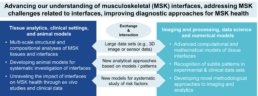
Our projects integrate synchrotron imaging, ultra-high-resolution electron microscopy (TEM, SBF-SEM, FIB-SEM), nano- and micro-CT, SAXS/WAXS, Raman spectroscopy, optical-coherence-tomography, advanced biomechanics, finite cell and finite element modeling, and AI-driven analytics into unified, correlative workflows.
Interface Research
Interfaces are where function emerges
In the context of musculoskeletal (MSK) health, interfaces are the transition zones where different biological structures, materials, or functional systems meet and interact. These regions are not simple boundaries; they are highly specialized, hierarchical, and dynamic structures that critically determine tissue performance, adaptation, and failure.
Rather than studying tissues in isolation, interface research focuses on the interactions between them.
An Interdisciplinary Research Team
Our Research Training Group unites biomedical engineers, biologists, mechanical engineers, physicists, clinicians, computer scientists, and data scientists to study musculoskeletal interfaces across scales. By combining expertise in imaging, biomechanics, MSK biology, and computational analytics, we foster close collaboration across disciplines and institutions. Doctoral researchers are embedded in interdisciplinary supervision teams and benefit from shared infrastructure, joint training, and a strong culture of exchange. This environment enables innovative, correlative research at the interfaces of musculoskeletal health.