

Excellence ThroughInterdisciplinary Collaboration
Collaborations and Academic Environment
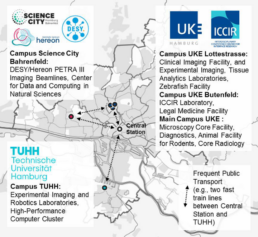
The “Multiscale Imaging and Analytics of Interfaces in Musculoskeletal Health” RTG is located in the vibrant Hamburg metropolitan area, which is an attractive region for both national and international researchers in the field of musculoskeletal imaging and health. Our RTG is built upon inter- and intra-institutional collaborations (see highlighted references in the bibliography) and upon established scientific relationships between several PIs. These have contributed to the ICCIR since its foundation in 2020, a competence center for interface research supported by UKE and TUHH. Adding to this, Hereon, with its outstation at the Science City Bahrenfeld, contributes its expert knowledge in synchrotron science. To facilitate research and collaboration, the RTG will have access to equipment and expertise at five laboratory campuses across the UKE, the TUHH, and Hereon.
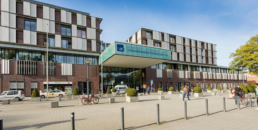
UKE in Hamburg is one of the largest university medical centers in Europe, offering top-tier medical care and pioneering research. In 2023, the University Medical Center Hamburg-Eppendorf (UKE) treated a total of 549,824 patients. This included 454,747 outpatient visits, 95,077 inpatient admissions, and 123,452 emergency cases. Multiple departments and clinics of the UKE focus on aspects of musculoskeletal medicine and foster an interdisciplinary and translational research environment. Musculoskeletal research is conducted to bridge the gap between basic science and clinical translation by employing clinical data, as well as animal models, specifically within the in-house zebrafish facility. The UKE campus provides state-of-the-art laboratory facilities equipped with a range of multiscale tissue characterization and imaging tools. Access to sophisticated imaging systems, including high resolution microCT, cutting edge clinical CT (PPCT and HR-pQCT), MRI, 2D and 3D high-performance electron microscopy, microscopy imaging facilities, and animal facilities for mouse models, is available through the UKE. The combination of clinical expertise, specialized research divisions, core facilities, and advanced imaging tools at the UKE contribute to an ideal environment for conducting cutting-edge research in musculoskeletal health.
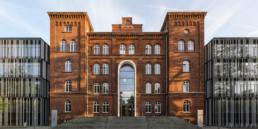
TUHH is a vibrant and dynamic university of technology with a strategic emphasis on interdisciplinary research and education, actively fostering international research collaborations and study programs. This is reflected in its innovative organization into five overarching research fields around grand challenges of our time: Advanced Materials & (Bio-)Processes, Aviation & Maritime Technologies, Cyber Physical & Medical Systems, Environmental & Energy Systems, Logistics, Mobility & Infrastructure. The Medical Technology and Biomechanics Research cluster fosters interdisciplinary collaboration among scientists with backgrounds ranging from computer science and electrical engineering to mechanical engineering and material science. Research groups from within this cluster will contribute expertise and technology, including mechanical testing devices and ultrasound and OCT imaging. Furthermore, the compute cluster at TUHH will be available for training machine learning models and to run numerical simulations. Offering both undergraduate and graduate programs in fields including biomedical engineering, computer science, electrical engineering, environmental engineering, and mechanical engineering, TUHH is also known for its innovative teaching and strong collaboration with industry. TUHH is part of several national and international networks of research and higher education, including the European Consortium of Innovative Universities (ECIU), and emphasizes the importance of a broader societal context. The university promotes interdisciplinary learning and encourages students to consider the social, economic, and environmental implications of their work. The international focus is also represented by 28% international students and most master level classes being taught in English, providing ample choice for PhD students in the RTG to broaden their knowledge
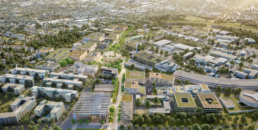
Hereon is a member of the Helmholtz Association of German Research Centers (i.e., a non-university research institution). Within the framework of the user access platform of the German Engineering Materials Science Centre (GEMS), several instruments, including neutron and synchrotron radiation (DESY PETRA III/IV), operate at large-scale facilities. The Institute of Metallic Biomaterials focuses on investigating the performance of biodegradable bone implants and their associated bone response. Multimodal and multiscale imaging methods are located at the DESY beamlines (materials physics division), offering state-of-the-art micro- and nanoCT with phase contrast capabilities, outperforming lab based microCTs in aspects of resolution and contrast. A high-performance cluster attached to the extensive storage facilities allows for large scale data processing. Hereon works closely with other research institutions and industries worldwide, aiming to transfer research findings into practical applications. This approach provides an excellent bridge between biomedical and engineering approaches.